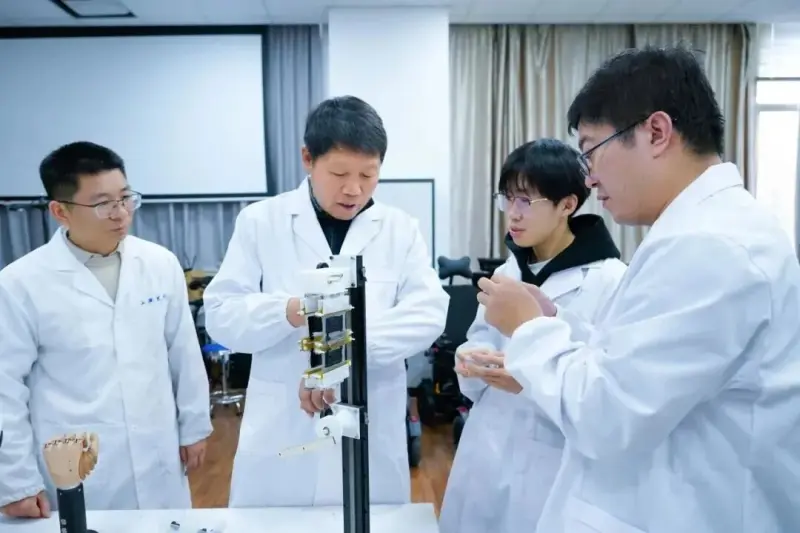
A research team at Shanghai Jiao Tong University has developed a high-performance electroactive artificial muscle for soft robotics, tactile interaction, and intelligent prosthetics. Their study, recently published online in Science, is titled “Semiseparated biphasic bicontinuous dielectric elastomer for high-performance artificial muscle.” The paper lists doctoral student Shi Xiaotian and Associate Professor Zou Jiang as co-first authors, and Professors Zhu Xiangyang, Gu Guoying, and Professor Lu Baoyang of Jiangxi University of Science and Technology as co-corresponding authors.
Developing electroactive artificial muscles with high performance has long been a challenge due to the limited electromechanical sensitivity of conventional dielectric elastomer materials under low driving electric fields. To address this, the team designed a semiseparated biphasic dielectric elastomer (SBE) using an “heterogeneous crosslinking induced phase separation” strategy. This approach increased electromechanical sensitivity to 360 MPa⁻¹, providing a new pathway for high-performance artificial muscles.
The SBE consists of two types of silicone elastomers with different crosslinking mechanisms. The high-dielectric D phase forms a continuous network through main-chain crosslinking, while the low-modulus mechanical M phase forms a mechanical skeleton through side-chain crosslinking. This bicontinuous structure maintains low modulus while increasing dielectric constant and breakdown field. Experiments showed that an SBE with just 10% D phase has a Young’s modulus of ~10 kPa and a relative dielectric constant of 3.6, achieving high electromechanical sensitivity. Artificial muscles made from this material achieved 90% area strain at 35 V/μm without pre-stretching.
The team further developed shear-type artificial muscles. Under low electric fields, these muscles achieved over 50% linear strain without pre-stretch, strain rates up to 400%/s, and energy density of 375 J/kg, demonstrating the advantages of the bicontinuous structure.
Stacked and rolled muscle designs were also produced. The stacked configuration achieved 21.76 kPa blocked stress and 2250 W/kg power density at high frequency. A 1.2-gram stacked muscle could repeatedly lift 300 grams with 91% linear strain.
To demonstrate applications, a humanoid robotic arm driven by four SBE muscles achieved 119.3° motion range and 0.24 N·m torque. A multimodal soft crawling robot reached 22 body lengths per second at 300 Hz and could switch between forward and backward motion, navigating complex and unstructured environments such as bent pipes and stomach models.
This research shows that careful material design, device fabrication, and robotic integration can improve electromechanical sensitivity, response speed, power density, and durability in artificial muscles, offering a new technical route for next-generation electroactive soft robots. The work was supported by the National Natural Science Foundation of China and the National Key R&D Program.
Paper link: Science