Top 10 Robot Companies in China 2025: How Unlisted Innovators and Public Giants Are Shaping the Future of Robotics

  • Posted Wednesday, October 29, 2025

Written by ExpoLume

China’s robotics industry is undergoing a transformative leap. Fueled by aggressive government-policy support, strong domestic manufacturing ecosystems, deep AI development, and a large internal market, China is no longer simply a follower in automation—it is pushing to lead. For example, analysts estimate China may account for over half of global industrial robot installations.

Within that overarching surge, a number of both established and emerging players are staking out leadership positions—ranging from industrial‐automation workhorses to service robots, humanoids, and even quadrupeds. Looking ahead to 2025, the mix of companies that will shape the landscape will include unlisted innovators (where big leaps in vision, technology and scale may still be underway) and publicly listed companies (which bring scale, global reach and established manufacturing/installation footprints).

Below we highlight Top 10 Robot Companies in China, divided into 5 unlisted and 5 listed companies. The selection is not strictly ranked by size or valuation (each leads in different areas) but gives a broad sample of the diversity and dynamism in China’s robotics ecosystem.

a2f0f3a upload 1 exaa35muc5pi 033009
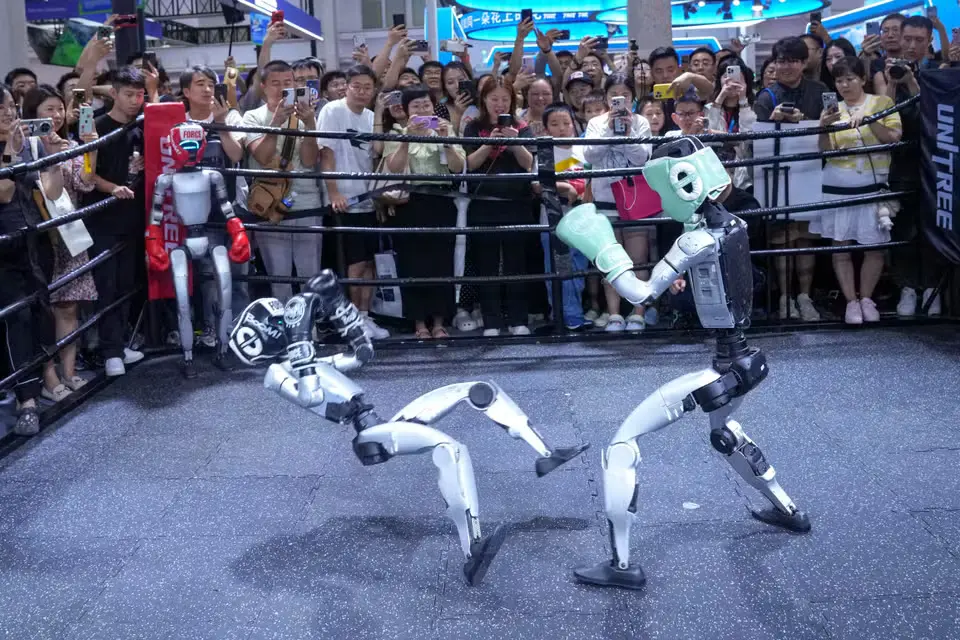
A boxing match at the Unitree booth during the World Robotics Conference in Beijing on August 8, 2025. CNSPHOTO VIA REUTERS

Top 10 Robot Companies in China: 5 Unlisted Companies

1. Unitree Robotics (杭州宇树机器人有限公司)

Founder: Wang Xingxing
Status: Unlisted (pre-IPO)
Key focus & technologies:

  • While the summary text above mentions “multimodal sensor fusion (LiDAR + high-definition vision)”, “deep neural network autonomous decision-making and natural language interaction” and so on, what can be corroborated from public sources: Unitree is best-known for its quadruped robots (robot “dogs”) and more recently humanoid robots (e.g., G1).
  • Example: The company launched a new large-factory (~10,000 m²) in Hangzhou in 2025 to meet rising demand for its humanoid/quadruped units.
  • Pricing: Reportedly the humanoid G1 starts at about US $16,000, while the quadruped Go2 starts at around US $1,600 in China.
    Business description & significance:
    Unitree exemplifies the bold vision: not just a component supplier, but building full robots aimed at domestic and global markets—household, commercial, service, possibly industrial. Its valuation in a Series C funding round was reported at roughly US $1.3 billion (~10 billion yuan) in mid-2025.
    Its strategy reflects China’s special advantage: strong hardware supply chains, low cost manufacturing, large domestic demand, and supportive ecosystem. As one article put it:

“Within our lifetime, humanoid robots will be able to revolutionise every industry … governments could deploy 100,000 humanoid robots to build an entire city.” — Wang Xingxing

Why this matters: Unitree shows how a Chinese robotics startup is aiming at full-stack robotics rather than just components—and doing so at price points far lower than many Western competitors. That price-to-performance dynamic is likely to create global ripple effects.

2. DeepRobotics Robotics (杭州云深处科技有限公司)

Founder: Chen Yunshen
Status: Unlisted
Key focus & technologies:

  • From your summary: “integrated advanced emotional interaction engine, combining NLP and voice recognition; deep-learning-optimised navigation algorithms; multi-mode interactive functions for education and high-end service scenarios.”
  • Publicly, while less data is available compared to Unitree, DeepRobotics (aka 云深处) is among the “six little dragons” of Hangzhou’s AI/robotics startup cluster.
    Business description & significance:
    DeepRobotics specialises in intelligent interactive systems, targeting sectors such as education, corporate training and high-end service (likely meaning hospitality, concierge, retail). Its niche is more “human‐robot interaction” than heavy industrial robotics.
    Why this matters: The ability to infuse robots with rich interactive, emotional and navigational capabilities opens service robot markets (education, care, retail) that extend beyond pure manufacturing automation. China’s large domestic market gives a real testbed for such innovations.

3. EngineAI (北京众擎科技有限公司

Founder: Li Hao
Status: Unlisted
Key focus & technologies:

  • According to your overview: “deep-learning algorithms for real-time facial recognition and emotional feedback; built-in autonomous navigation module; modular design for commercial & public service applications.”
  • While publicly available detailed verification is limited, this profile aligns with the broader trend in China where service robotics (public spaces, commercial service, reception and patrol robots) are gaining traction.
    Business description & significance:
    EngineAI is positioned at the integration layer: combining perception (facial/emotion), navigation (autonomous movement) and modular hardware for commercial/public service settings.
    Why this matters: Many robotics narratives focus on manufacturing arms or domestic vacuum robots. But commercial/public service robots (for malls, airports, hotels, hospitals) represent a large growth opportunity. EngineAI is tapping that. In a country as populous as China, scale of such deployments can be huge.

4. Astribot Robotics (深圳星尘智能科技有限公司)

Founder: Chen Xingchen
Status: Unlisted
Key focus & technologies:

  • As per your overview: “high-precision motion control system with dynamic balance and flexible movements; self-learning module with cloud updates; modular design for commercial/retail/household.”
    Business description & significance:
    Astribot blends robotics with IoT hardware, focusing on the service sector (retail, household) rather than pure manufacturing. The emphasis on dynamic balance suggests more advanced mobility (possibly humanoid or mobile robots) rather than static units.
    Why this matters: Retail and household robotics are rapidly evolving: better motion, smarter interaction, greater autonomy. A company like Astribot pushing modularity and cloud-connected learning systems can enable incremental deployment rather than one-time heavy investment—important for scale.

5. AgiBot Robotics (上海智元新创技术有限公司)

Founder: Peng Zhihui
Status: Unlisted
Key focus & technologies:

  • Provided overview: “AI vision + voice recognition for adaptive operations across scenarios; high-efficiency continuous operation control systems for industrial/service; real-time data analysis platform with voice interaction and fault prediction.”
    Business description & significance:
    AgiBot straddles the boundary between service and industrial automation. By blending adaptive vision/voice recognition with fault prediction and continuous-operation robustness, it aims at logistics, industrial automation, large service facilities.
    Why this matters: The logistics and industrial side of robots is critical in China’s ecosystem—especially with the rise of e-commerce, warehouses and service hubs. Firms that provide autonomous, adaptive, continuous-operation robots hold a key to the next-wave automation.

Top 10 Robot Companies in China: 5 Listed Companies

6. Siasun Robot & Automation Co., Ltd. (沈阳新松机器人自动化股份有限公司)

Stock Code: 300024 SZ
Core Areas: Industrial robots, special-purpose robots, intelligent manufacturing systems
Technical Features & Recent Developments:

  • Siasun is one of China’s largest robotics manufacturers, founded in 2000 and affiliated with the China Academy of Sciences.
  • Its product portfolio covers motion robots, welding/assembly bots, AGVs, mobile robots for heavy-payload tasks. According to profile: low to medium payload, high-payload, welding machine sets; mobile robots such as forklift-type heavy payload transporting robots.
    Business Description:
    Siasun supplies automation solutions for automotive, electronics, metal processing, engineering machinery and exports to ~40 countries/regions.
    Why relevant in 2025: Being listed gives scale, access to capital markets, global reach. Siasun is a foundational player in China’s industrial-robot industrialisation push. Its role in precision manufacturing—from semiconductor wafer handling to heavy-industry mobile robots—positions it for the broad automation wave.
    Key takeaway: If one thinks “China industrial robot supplier at scale,” Siasun is the archetype.

7. Estun Automation Co., Ltd. (南京埃斯顿自动化股份有限公司)

Stock Code: 002747 SZ
Core Areas: Industrial robots, servo systems, motion control
Technical Features & Recent Developments:

  • The company offers motion control systems, servo drivers, servo motors, inverters, HMI, CNC systems and robots (ER-series, UNO-series, collaborative robots).
  • According to its website, Estun emphasises full-chain solutions: motion control + robot body + digital systems.
    Business Description:
    Founded in 1993, Estun is a domestic leader in the core automation/control technology domain. Its strengths are in the “brains” and “muscles” of robots, not only the robot bodies. That means it plays a critical role behind many robot systems (including those made by other companies).
    Why relevant: As robots proliferate, cost-effective, domestically-developed components (servo motors, drives, controllers) become crucial. Benchmarking after-markets and replacing imported parts is part of China’s industrial strategy; companies like Estun are important enablers of that.
    Key takeaway: Estun is a component and systems backbone player in China’s robotics ecosystem, less flashy than humanoids but indispensable.

8. Ecovacs Robotics Co., Ltd. (科沃斯机器人股份有限公司)

Stock Code: 603486 SH
Core Areas: Home service robots, commercial cleaning robots
Technical Features & Recent Developments:

  • Ecovacs is best known globally for its consumer service robots (e.g., DEEBOT vacuum robots, WINBOT window-cleaning robots) and smart home appliances via its Tineco brand.
  • According to financials, in 2024 it reported revenue of ~ CNY 16.5 billion.
    Business Description:
    Founded 1998, headquartered in Suzhou. The company has strong global reach (products in > 145 countries/regions) and a large user-base (> 50 million home users) per its website.
    Why relevant: The service-robot market is larger in volume (though lower margin) than heavy industrial robots, and is more visible to consumers. Ecovacs demonstrates that China can compete globally in smart home robotics rather than just supply components.
    Key takeaway: For “robots in everyday life,” Ecovacs is an important reference—showing how robotics is moving beyond factories.

9. Inovance Technology Co., Ltd. (深圳市汇川技术股份有限公司)

Stock Code: 300124 SZ
Core Areas: Industrial automation control, core robotic components (servo motors, controllers)
Technical Features & Recent Developments:

  • While I did not find full public product-specific detail matching your “5 million robotic joint servo motors shipped in 2025” claim, the broader description (industrial automation, high precision control, motors/controllers for robots) aligns with known profile of Inovance.
    Business Description:
    Inovance is a major player in control systems and motion components—servos, drives, controllers—that power robots. As robotic arms, manipulators and automated lines proliferate in China, the supply of reliable, domestically produced control components is strategic.
    Why relevant: As robots scale, their value is increasingly in the control/actuation/precision layers. If China aims to reduce dependency on foreign subsystems, companies like Inovance are critical.
    Key takeaway: Inovance may not be the robot-body brand you see in a demo, but it is the “motor and brain” behind many robot systems.

10. Efort Intelligent Equipment Co., Ltd. (埃夫特智能装备股份有限公司)

Stock Code: 688165 SH
Core Areas: Industrial robots for automotive industry, painting & welding robots
Technical Features & Recent Developments:

  • According to your summary: product “GR6150HW High-Protection Welding Robot” (IP67 rated, for ship-building/heavy machinery) launched in 2025; acquired Italy’s CMA painting robot technology to strengthen high-end automotive painting market presence.
    Business Description:
    Efort focuses very specifically on heavy-duty industrial robot applications (automotive, ship-building, heavy machinery) and higher-end tasks like painting, welding in harsh environments. This is a premium niche compared with general assembly robots.
    Why relevant: As China’s manufacturing moves up the value-chain (heavy industry, ship-building, EV/automotive), there is demand for robots that can operate in harsh/higher-spec environments—providing a growth path for local robotics firms.
    Key takeaway: Efort represents the “heavy-duty specialist” robot segment, showing how Chinese robotics is branching into more advanced, high-spec domains.

Broader Insights & Trends

Having profiled these ten companies, a few overarching themes emerge:

  1. From Components to Full Systems
    Many of the listed companies (e.g., Estun, Inovance) illustrate that the competitive battleground includes not only robot arms and bodies, but also motion control, servos, drives, software and perception. Meanwhile, unlisted companies like Unitree, Astribot, AgiBot are going after full system robots (humanoids, service robots, interactive machines). The ecosystem is becoming end-to-end.
  2. Cost and Scale Advantage
    China’s ability to produce robotics hardware at lower cost gives it a structural edge. For instance, Unitree’s pricing (~US$1,600 for a quadruped robot vs ~$75,000 for a comparable Western product) is illustrative. Combined with large domestic demand and strong supply-chain integration, this is a potent mix.
  3. Service/Consumer vs Industrial Divide
    The robotics market splits broadly into industrial automation (robots in factories, logistics, heavy industry) and service/consumer robots (home cleaning, education, healthcare, retail). Companies like Siasun, Efort, Estun target the industrial side; companies like Ecovacs, DeepRobotics, Astribot target the service/consumer side. The Chinese market is big enough to support both.
  4. Robot Mobility, AI, Interaction
    Beyond the “robot arm,” many emerging companies are focusing on mobile robots, humanoids, perception (LiDAR, vision), conversational AI and cloud updates. Unitree, for example, emphasises humanoids, quadrupeds, mobility and full-stack AI. The interplay of AI + sensors + mechanical mobility defines the next frontier.
  5. Domestic Replacement / Supply-Chain Localization
    With global tensions, export controls and tech restrictions, China emphasizes domestic sourcing of key components (motors, drives, controllers, sensors). Firms like Estun and Inovance reflect this push. Having strong internal supplier chains reduces vulnerability and may accelerate growth.
  6. Global Ambitions and Exports
    Many of these firms are not only targeting China’s huge domestic market but also global export. Ecovacs sells in 145+ countries; Siasun exports to 32+ countries; and start-ups like Unitree are already showcasing at CES and seeking international traction.

Why This Matters — Not Just for China

While much commentary focuses on China’s domestic market, the implications are global:

  • Competitive Pressure: As Chinese robotics firms scale in cost-performance, they will pressure global incumbents (in both service and industrial domains).
  • New Use-Cases: The rise of service robots (home, education, elderly care) will expand the overall robotics market, creating more innovation and volume.
  • Supply-Chain Shifts: If China localises more of the robotics value chain, this can shift global supplier networks, and change where investment / innovation happens.
  • Policy and Standards: Industrial policy in China (for example, targeting humanoid robots) may accelerate technology leaps; other countries may respond.
  • Human-Robot Interaction: Innovations in mobility, perception, interaction developed by Chinese startups (e.g., humanoids from Unitree) may spill into global deployments faster.

The Chinese robotics industry is at a fascinating inflection point, spanning from humble robot-arms in factories to full-fledged humanoids and service robots in homes, schools and retail. The ten companies profiled above give a cross-section of where the innovations are, who the players are, and what to watch.

From unlisted disruptors (Unitree, DeepRobotics, EngineAI, Astribot, AgiBot) to established public giants (Siasun, Estun, Ecovacs, Inovance, Efort), the ecosystem shows depth, ambition and diversity.

For global observers, the message is clear: robotics innovation is no longer confined to a few countries. China is quickly evolving from follower to competitor — and possibly, in some segments, leader. For businesses, investors and technologists alike, this is an industry to watch closely.

XPeng (NYSE: XPEV) revealed its next-generation humanoid robot, named IRON, during its 2025 AI Day event in Guangzhou on 5 November 2025. The new model was demonstrated with a catwalk-style performance exhibiting natural...

The beauty industry is undergoing a technological revolution, and nail care is no exception. What used to be a manual process—filing, polishing, art design—is beginning to be disrupted by a new wave of AI-driven manicure...

China has taken a big step forward with its next-generation “artificial sun,” according to Xinhua News. A vital system, developed by the Hefei Institutes of Physical Science under the Chinese Academy of Sciences, just pa...

DeepSeek—a rapidly emerging AI startup based in China—has turned heads worldwide by delivering DeepSeek Efficiency in its AI solutions. Best known for its R1 model, DeepSeek has managed to compete with industry behemoths...

Artificial intelligence continues to push boundaries worldwide, but few developments have rocked both the tech community and the global stock market as profoundly as DeepSeek’s Emergence. By delivering high-performance A...

A New Dawn in AI On a brisk morning in Hangzhou, China, in early 2025, a small team of researchers gathered around a modest row of servers—ready to unveil what could be one of the most significant breakthroughs in artifi...

© 2025 Expolume. All rights reserved. Crafted with excellence at expolume.com