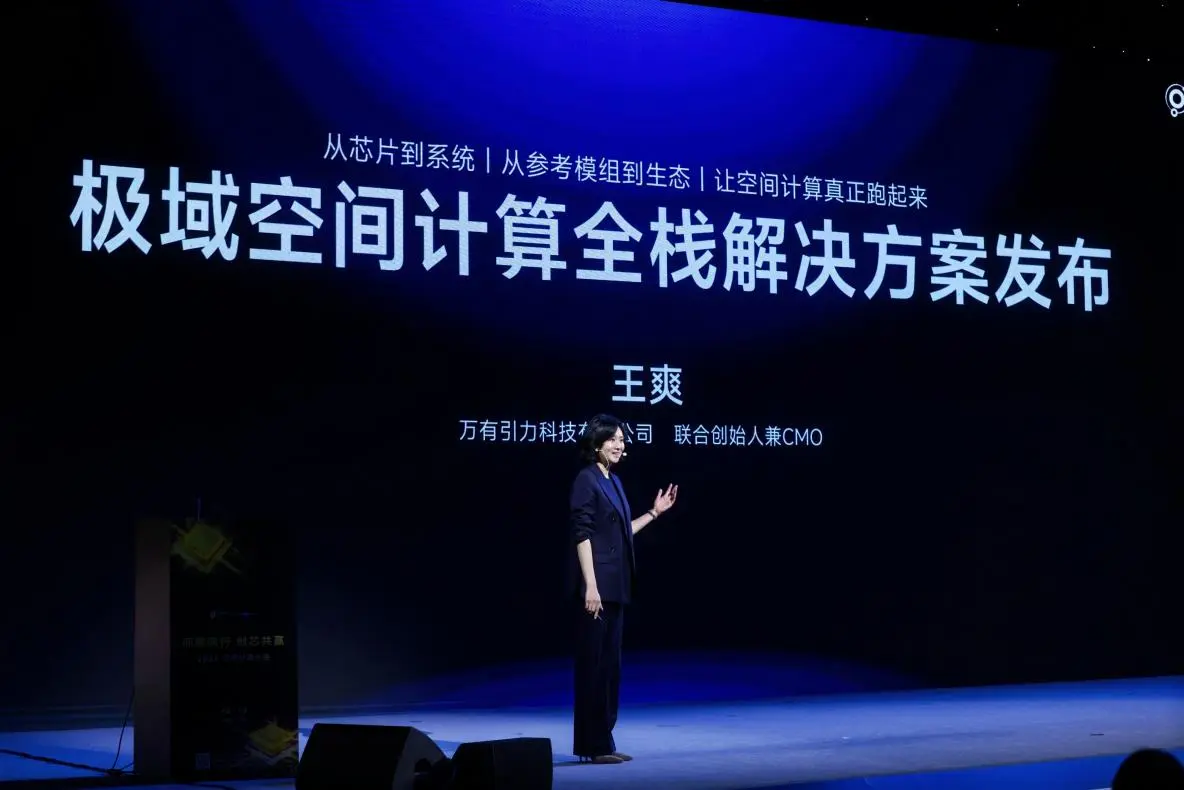

At the 2025 Spatial Computing Conference on November 27, 2025, GravityXR unveiled a full stack spatial computing solution called Jiyu. The platform spans the entire chain from chips to devices, spatial engines, software development kits and ecosystem integration. It supports multiple fields including extended reality, robotics, automotive systems and industrial applications. The goal is to solve the full path from computation to capability, enabling spatial computing to operate efficiently while shortening the journey from concept to commercialization for enterprises.
GravityXR positions Jiyu as a unique end to end self developed platform that allows companies to enter rapid prototyping and mass production. Co founder and chief marketing officer Wang Shuang explained that Jiyu represents pushing to the limits, expanding to new domains and giving industry the ability to make spatial computing practical. It also signals new opportunities by lowering the barriers created by complex underlying technologies.
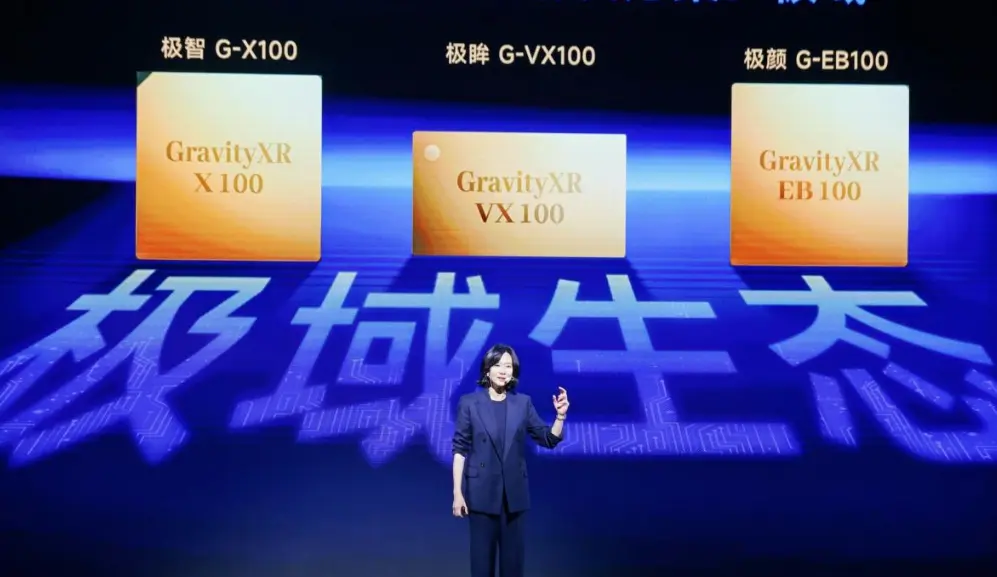
The Jiyu ecosystem is built on a clear multilayer structure. At the foundation are three newly released self developed chips. The flagship chip, Jizhi G X100, is China’s first full function mixed reality spatial computing chip. Based on a five nanometer process with a heterogenous Chiplet structure, it achieves end to end color passthrough latency as low as nine milliseconds, a world record. It supports dual eight K resolution at one hundred twenty hertz, full pipeline eye tracking computation and a split device architecture, all with only three watts of power consumption on the headset side. The chip is compatible across platforms and is designed to fit advanced mixed reality performance into glasses weighing under one hundred grams.
The two additional chips include Jimou G VX100, a four point two millimeter single sided package suited for lightweight AI and augmented reality glasses as well as AI earphones. It features low power consumption, multimodal wake up and high image quality. Jiyan G EB100 offers low power spatial rendering for extended reality devices and robots and already supports real time digital human facial animation.
To accelerate product delivery, the device platform layer provides reference modules and full device templates that encapsulate engineering challenges such as multisensor calibration and optical alignment. The X100 M1 module allows manufacturers to complete industrial design, structural integration and application development in about six months, reducing a traditional development cycle of more than a year by roughly one third. A supporting PCMR development platform offers real hardware environments for debugging and early validation. Future reference designs will include the A1 glasses based on the VX100 chip and the H1 robotic head module based on the X100 chip.
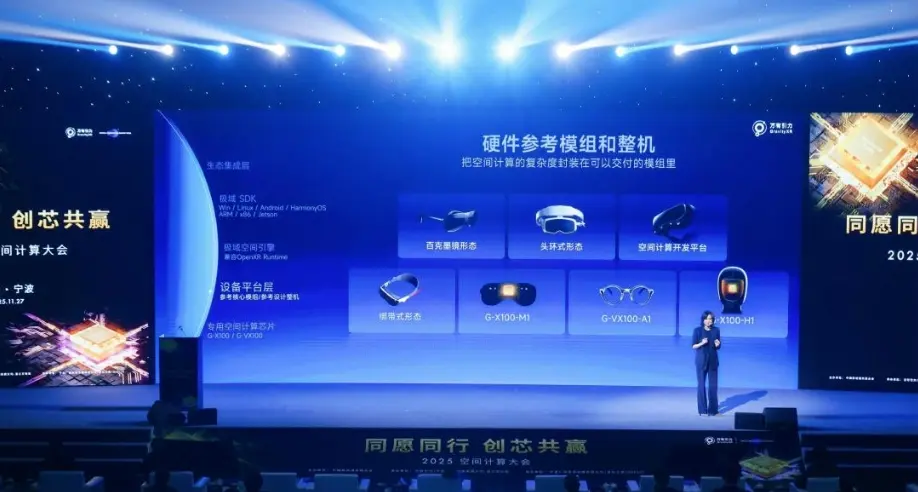
The spatial engine layer integrates perception, world understanding and application output. It supports tracking, simultaneous localization and mapping and multisensor fusion along with OpenXR compatible interfaces. A single spatial engine can support extended reality devices, robots and drones with reusable capabilities.
The SDK layer enables cross operating system and cross processor development. It supports Windows, Linux, Android and HarmonyOS as well as x86, ARM and vehicle grade system on chips. Developers can build once using Unity or Unreal Engine and deploy across multiple devices. According to the roadmap, a preview SDK and beta runtime will launch in mid twenty twenty five with version one point zero expected by year end.
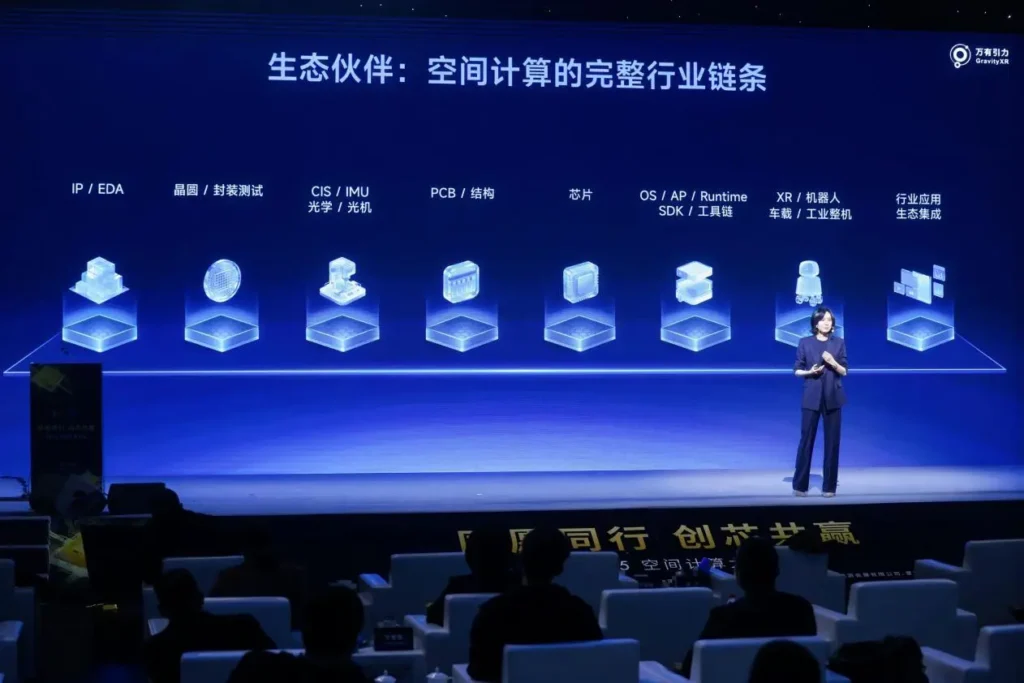
Jiyu’s ecosystem is co built with nearly three hundred partners across chip supply chains, system integration and early alpha customers. At the conference, government agencies, research institutions and industry partners jointly initiated a full chain spatial computing ecosystem alliance. Gravity Electronics also expanded cooperation with companies in optics, robotics, extended reality and consumer electronics.
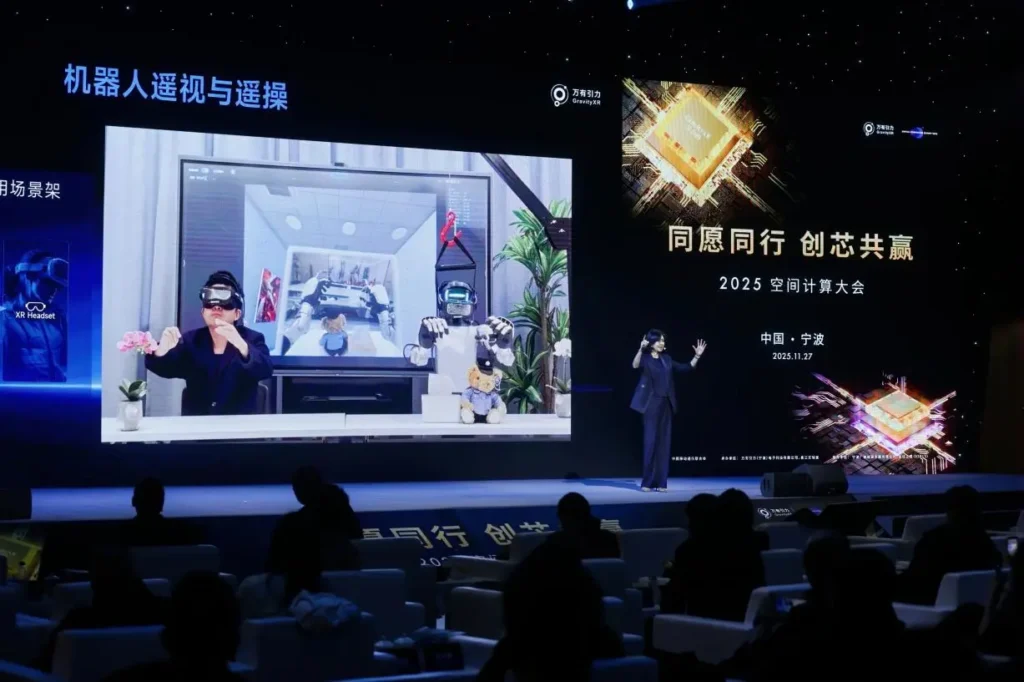
Live demonstrations included a robot possession system where users remotely control a robot through a mixed reality headset powered by the G X100 chip. The system plans to incorporate facial expression synchronization for remote service and companionship scenarios. Another demonstration featured a Windows mixed reality multitasking system that arranges two dimensional applications freely in three dimensional space.
Founded 2021, GravityXR has completed multiple financing rounds and achieved a multibillion valuation. Founder and chief executive officer Wang Chaohao said the team worked for one thousand ninety two days to design the X100 chip and push mixed reality products toward the one hundred gram era. Wang was recently listed among the Hurun U40 China Entrepreneurship Pioneers alongside other notable innovators.
With deep expertise in semiconductors, algorithms and system architecture, the company continues to invest in core spatial computing technologies. Industry observers believe its chip architecture and full stack system will accelerate the adoption of extended reality and signal a new starting point for the spatial computing era. They expect that future headsets, robots, vehicles and industrial systems will all possess spatial awareness, perception and interaction capabilities, enabling seamless integration between the digital and physical worlds.