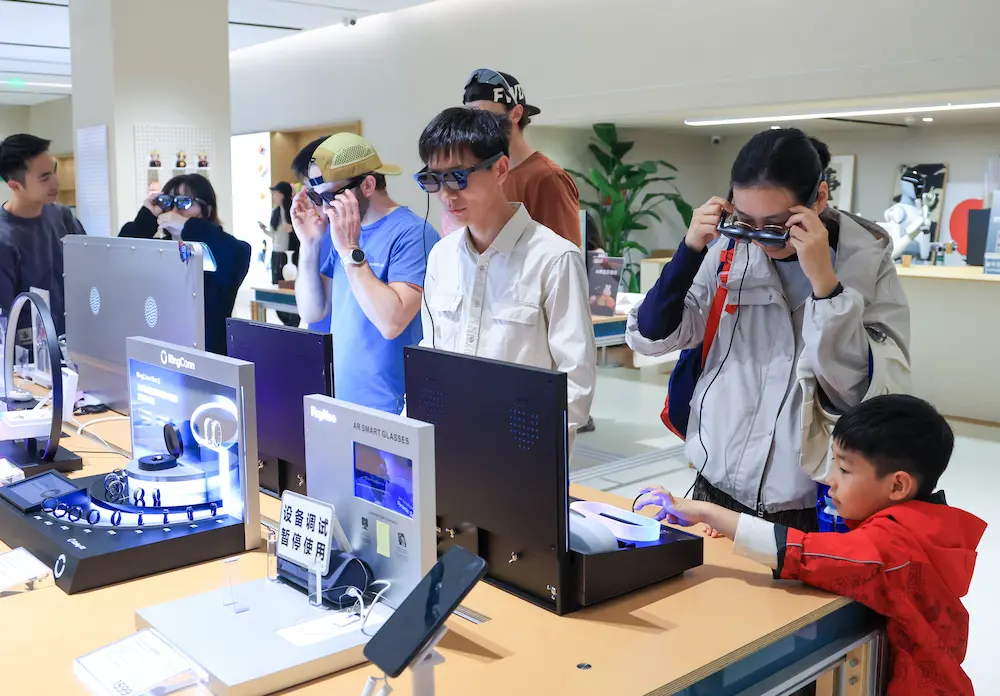

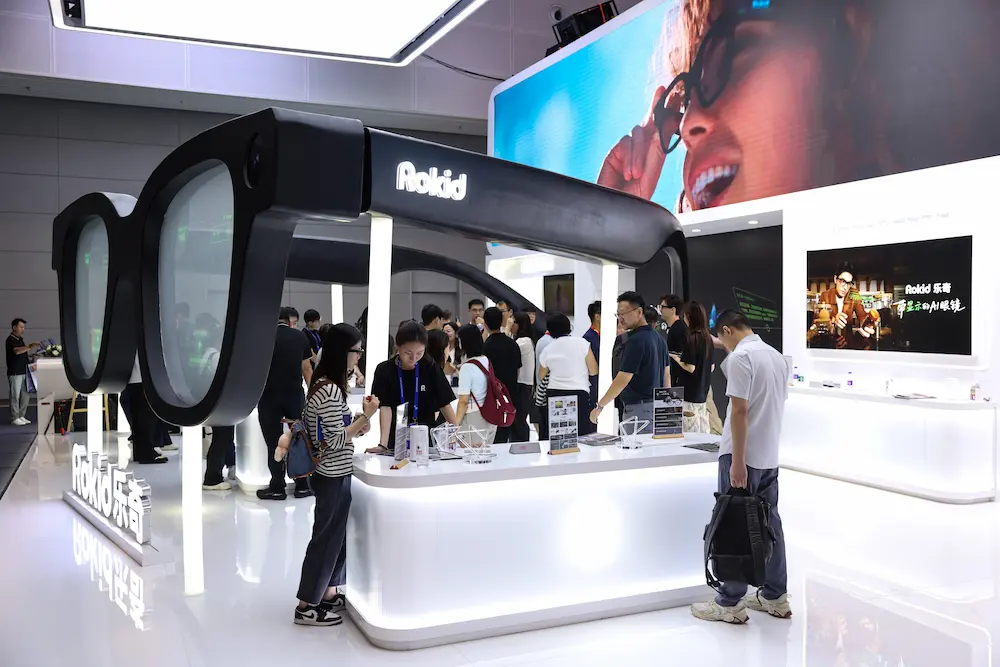
After the rollout of national consumer subsidies, customer traffic for smart glasses trials and consultations increased significantly in Beijing retail stores. Staff reported higher charging frequency for demo units due to increased usage.
Driven by novelty and government subsidies, smart glasses have become a popular New Year purchase. The device is widely positioned as the next-generation mobile terminal. The issue is whether it can move beyond novelty status into sustained daily use.
Market Expansion in 2025
China’s smart glasses market saw rapid growth in 2025. According to RUNTO, annual sales volume including AR glasses reached 1,454,000 units, a year-on-year increase of 211 percent.
Compared with smartphones, which ship in the hundreds of millions annually, smart glasses remain a niche category. However, growth momentum is significant.
Major companies including Alibaba, Baidu, ByteDance, Huawei, and Xiaomi have entered the sector, intensifying competition across internet platforms, smartphone makers, and automotive firms.
Wang Yongxue, Associate Dean of the School of Integrated Circuits at Shenzhen Polytechnic University, stated that leading companies are competing for control of the next mobile computing platform rather than following trends.
Wang Junjie, Vice President of Lingban Technology, said smartphone screen size and interaction methods have reached physical limits. Smart glasses, positioned closest to the human brain and capable of multimodal information perception, are viewed as an effective bridge between AI, the physical world, and the digital world.
Zhao Xiaogang, Associate Director of the Software Engineering Department at Wuhan University’s School of Computer Science, stated that smart glasses provide more immersive interaction, larger display areas, and true hands-free operation compared with smartphones and computers.
Zhang Guofeng, Professor at Zhejiang University’s College of Computer Science and Technology, described Xiaomi’s entry into the field as a natural strategic move.

Wang Yongxue noted that competition in AI large models requires real-world deployment scenarios, accelerating development in wearable AI hardware.
Si Weixin, Associate Professor at the School of Computer Science and Artificial Intelligence at Shenzhen University of Advanced Technology, stated that companies are positioning themselves for future AI-driven human-computer interaction gateways and digital sovereignty in the next computing era.
Globally, the traditional eyewear market is large. Wang Yongxue stated that replacing only 10 percent of traditional glasses could create an industry worth tens of billions of US dollars. Smart glasses combine fashion accessory and intelligent terminal attributes, aligning with consumer upgrade demand.
He emphasized that competition now centers on ecosystem construction, user habit formation, and commercial value extraction rather than hardware specifications alone.
Product Categories and Pricing
Current smart glasses on the market span a wide price range from CNY 1,000 to nearly CNY 10,000. Using an exchange rate of 1 CNY ≈ 0.14 USD, this equals approximately:
USD 140 (CNY 1,000)
USD 1,400 (CNY 10,000)
Products fall into two categories:
- Non-display models offering calls, music playback, voice interaction, and in some cases first-person photography.
- Display-equipped models supporting navigation, real-time translation, teleprompting, and other practical functions in addition to core features.
Despite rapid product releases, some consumers report that while the devices are suitable for short-term experimentation, they remain uncomfortable for regular long-term wear.
Wearability and Technical Constraints
Weight is a primary concern. Traditional glasses weigh about 20 grams. Mainstream smart glasses weigh between 40 grams and 80 grams, creating noticeable burden during extended use.
Battery life is another limitation. Manufacturers advertise 4 to 8 hours of endurance. In practice, when AI interaction, photography, and navigation are activated simultaneously, battery life often drops to 2 to 3 hours.

Zhao Xiaogang described the core technical barrier as the “impossible triangle” of battery life, weight, and display capability. Larger processing chips are required for stronger display performance and continuous service, increasing size and energy consumption.
Balancing these factors requires advanced semiconductor fabrication processes, mature display technologies, and higher-density battery solutions.
To reduce weight, some manufacturers offload computing tasks to smartphones, leaving sensing and display functions to the glasses. Zhang Guofeng stated that this design makes such devices highly dependent on smartphones, functioning more as accessories than independent terminals.
From Novelty to Routine Use
Industry observers believe the next three years will be decisive for transitioning from experimental adoption to routine daily use.
Si Weixin explained that early products adopted mature smartphone chips to lower development barriers and accelerate release, but suffered from higher power consumption and heat generation.
Most current products now use specialized chip platforms. Some brands adopt the Snapdragon AR1 platform, optimized from Qualcomm smartphone architecture specifically for AR devices. This platform achieves improved balance among performance, power consumption, and device size, becoming mainstream in mid-to-high-end consumer AR glasses.
Some devices also employ dedicated co-processor architectures to improve overall energy efficiency and optimize functions such as audio processing and image recognition.
Smart glasses powered by domestically developed chips have also entered the market.
Future development directions include full-color display systems and AIOS, an operating system designed specifically for smart glasses.
Wang Junjie stated that AIOS will be the defining keyword this year. Critical capabilities include camera-based environmental recognition, microphone-based voice understanding, and real-time feedback, enabling genuine hands-free operation.
Li Hongwei, Founder and CEO of RayNeo Innovation, stated that most current AR glasses use single-green display schemes, limiting visual richness. Full-color display is necessary to support complete information presentation and build a functional application ecosystem.
He argued that consumers increasingly seek immersive spatial experiences rather than static image viewing. Advances in spatial computing and AI integration are required to transform smart glasses from expensive displays into practical personal intelligent assistants.
Zhang Guofeng stated that without solving comfort and wearability, even strong functional performance will not enable mass adoption.
Sources: Xinhua News Agency, China Government Network